
Angela China
Moods of Nature
October 14th - November 11th, 2026
Opening: October 14th, 6-8 PM
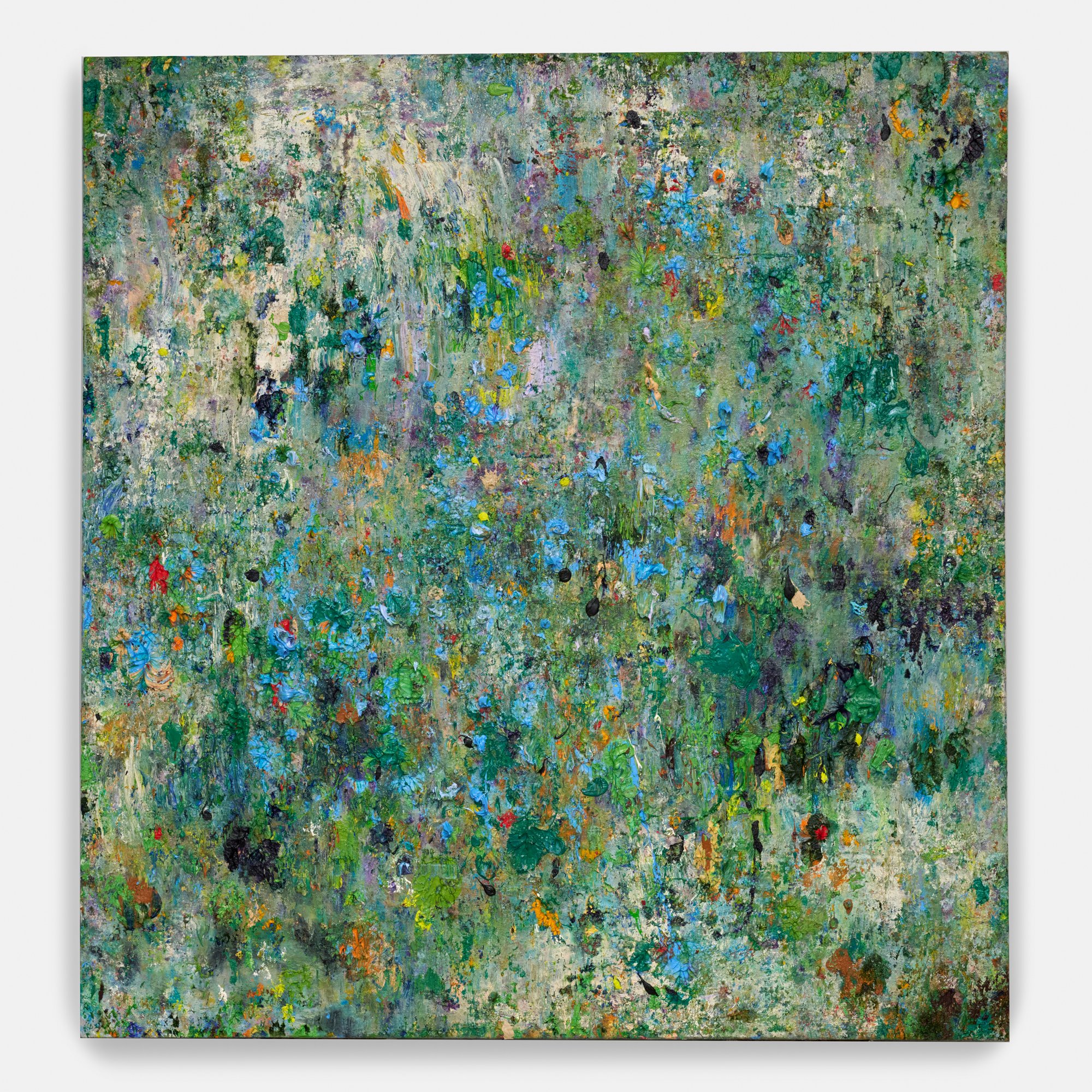
In May, the artist Josh Kline gave a talk at St. Mark’s Church off 2nd Avenue where he touched on the disposability of imagery in the 21st Century. The daily visual bombardment, he argued, has dulled our capacity to store pictures in our brain, but objects - physical objects be they sculptures or paintings - have a greater ability to make lasting impressions. The abstract work of Angela China speaks to this conundrum in subtle ways. Her almost archeological building up of compositions, the resulting topography of her pictures, remind us that every layer is a history. Her art hovers between landscape and landslide, deep space and the confrontation of thick oil paint at close proximity.
Her current exhibition "Moods of Nature" is a psychological excavation revealing influence, happenstance and consideration. Normally the term “decollage” is used to describe, say, the photos of Aaron Siskind or the process of Mark Bradford which both carry narrative explicitness. China creates this same tactile effect with a single medium, free from media-mixing, liberated from direct representation. Shapeshifting as an end result, the negation of naming elements for perpetuity.
"I'm obsessed with painters from Titian and Goya through Impressionism and into Modern and contemporary figures like Bacon, Joan Mitchell, and Cecily Brown,” explains the artist. “My work is in constant conversation with them. In my paintings you can see echoes across centuries and traditions, yet the work still asserts its own voice - my voice."
Nature itself is not a static enterprise, not a closed loop, rather a spiral that returns to perennials in fresh unforeseen variants. Nature hates a straight line. A painting like “Pink Sky” suggests flora and fauna, yes, but even the title itself poses a contradiction of permanence. Angela embraces the elemental in all its beauty, complexity, and chaos. She seeks dissonance as a form of resolution in her work. So many contemporary legends started off as street artists, rarer though to have a female painter with roots in graffiti. In another life, she was known by her tag, “Gumshoe,” a pair of women’s legs with one foot stuck trailing a wad of bubblegum. The name also reads as a throwback to what we once called private detectives. So what exactly is she investigating? “I began as a figurative painter, depicting the female form. Because I refuse to discard a canvas, I arrived at abstraction through persistence: through hundreds of failed paintings I refused to abandon,” concludes China. “I work over and through each surface, allowing every canvas to become a cumulative archive of missteps, revisions, and endurance. I scrape back layers to expose what came before, trusting that meaning reveals itself over time. I am drawn to an aesthetic of erosion and survival - to surfaces that feel weathered, marked by what they have endured.”